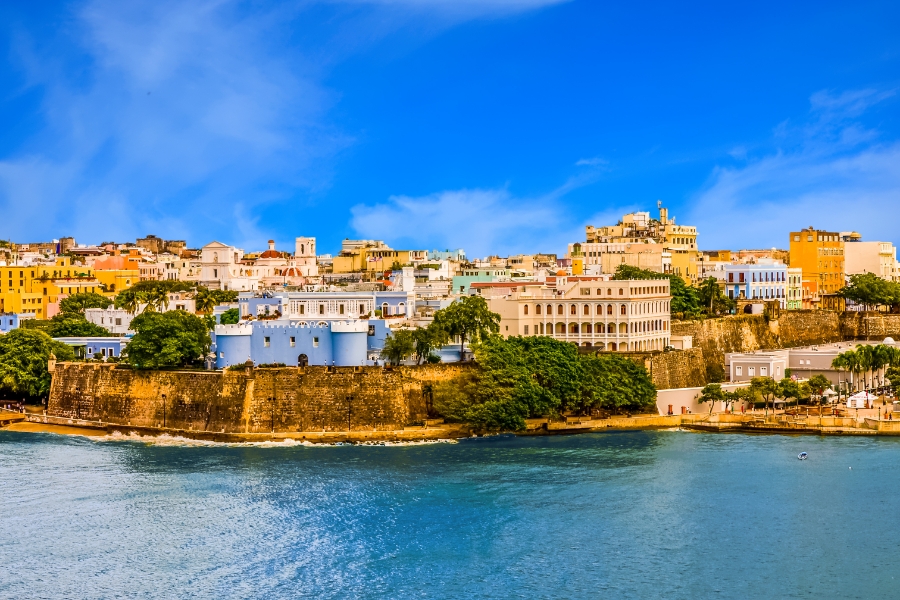
San Juan’s architecture tells a story of centuries, blending old-world charm with tropical flair. From Spanish colonial forts and pastel houses to sleek modern high-rises, you’ll find San Juan architecture as vibrant as its culture. Here, we’ll explore routes that showcase San Juan’s historic buildings and contemporary structures. By the end, you will know exactly where to go and why it’s best to explore by renting a car.
San Juan’s streets reveal the city's growth over time, from Spanish forts and colonial homes to modern buildings designed for the tropical climate. These routes are grouped by area and design . Each route can be explored either on foot or by car.
This route immerses you in the 16th-century heart of San Juan, where Spanish Colonial design defines every street. Narrow cobblestone lanes, thick masonry walls, and shaded courtyards create natural cooling. It’s an early example of climate-responsive architecture. You’ll walk across the famous blue adoquine cobblestones, cast initially from furnace slag once used as ballast on Spanish ships. This historic recycling practice gave the streets their bluish sheen.
As you explore, you’ll pass rows of colorful colonial homes with ornate iron balconies, tall wooden shutters, and central courtyards designed for shade and cross-ventilation in the tropical climate. Many buildings date back to the 1700s or earlier. The Catedral de San Juan Bautista, standing since 1521, is one of the oldest cathedrals in the Americas and features rare medieval Gothic details alongside the marble tomb of Spanish explorer Ponce de León.
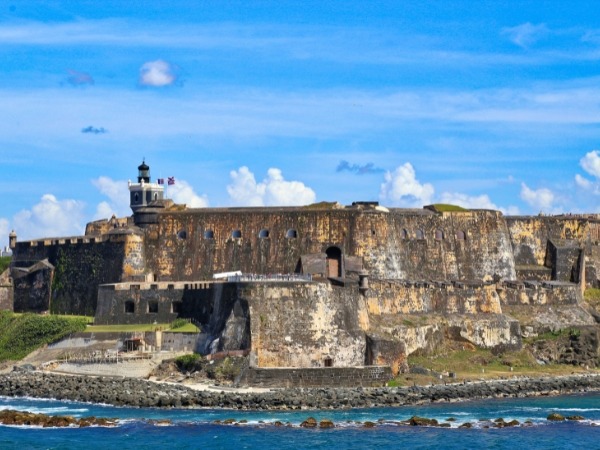
You’ll also encounter La Fortaleza, the Governor’s Mansion built in 1533, part of the same historic defensive system as the monumental forts that protect the city. The stone ramparts of Castillo San Felipe del Morro (El Morro) and Castillo San Cristóbal dominate the coastline. Walking this route gives you a close look at scalloped cornices, carved wooden balconies, pastel façades, and clay-tile rooftops that define the district’s character.
This scenic route traces the 18th-century defensive perimeters of Old San Juan. It reveals how the city’s early planners blended massive fortifications with elegant public spaces. The stone walls, some up to 20 feet thick, were engineered to resist cannon fire and form part of a UNESCO-recognised system of military defenses adapted to Caribbean terrain. As you walk, you’ll see how Neoclassical touches, such as plazas and fountains, softened the imposing military structures into welcoming civic areas.
Begin at Paseo de la Princesa, a 19th-century promenade that curves gently along the base of the old city walls. Shaded by almond and ceiba trees and lit by Victorian lampposts, the walkway feels like stepping into a bygone era. On one side looms the weathered city wall with its picturesque garitas (sentry boxes), once used by Spanish lookouts and now symbols of Old San Juan. On the other side, San Juan Bay glimmers through breaks in the trees.
Midway along the promenade stands Antigua Prisión La Princesa, a former prison built in 1837. Soon after, you’ll reach the spectacular Fuente Raíces (“Roots Fountain”), a bronze masterpiece celebrating Puerto Rico’s Taíno, Spanish, and African heritage. Its dynamic sculptures and waterfront backdrop make it one of the most photogenic stops on the route.
Continue toward the Puerta de San Juan, the massive city gate built in 1635 that once served as the primary seaward entrance to the fortified town. The thick stone ramparts and heavy wooden doors evoke centuries of maritime history. Passing through, you arrive at Paseo del Morro, a coastal trail skirting the cliffs beneath El Morro fortress. Here, sweeping views of the bay meet the silhouette of Old San Juan’s fortifications.
Puerta de Tierra (“Land Gate”) is the narrow isthmus that connects Old San Juan to the rest of the city. It showcases the early 20th-century civic architecture that emerged under strong U.S. influence. As you drive or bike through this district, you’ll encounter grand Neoclassical and Beaux-Arts buildings made of white marble and concrete.
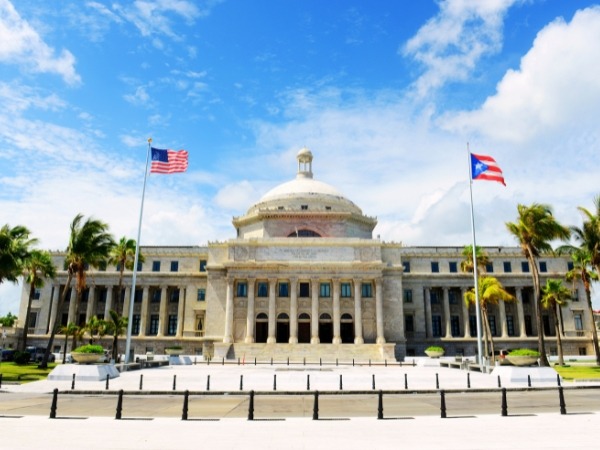
Leaving Old San Juan’s eastern walls near the former Santiago Gate. Along Avenida Muñoz Rivera, monumental structures dominate the landscape. The most iconic is El Capitolio, the Capitol of Puerto Rico. Built between 1921 and 1929, this imposing Neoclassical landmark was modelled after Columbia University’s Low Library. The building features a Corinthian-columned portico and a gleaming white marble dome. Climb the broad marble steps, and you’ll notice inscriptions on either side. One is Spanish (“El derecho, la libertad y la dignidad por encima de todo”) and the other is in English, quoting Lincoln.
Other distinguished civic structures surround the Capitol grounds. The Department of Justice building and the Antiguo Casino de Puerto Rico are standout stops. The Antiguo Casino, built in 1917, is a Beaux-Arts masterpiece featuring French-inspired ornamentation, lush gardens, a balustraded terrace, and an opulent grand staircase that was once used for high-society galas. As you continue, you may also spot the Puerto Rico Supreme Court with its mid-century classicist design, as well as the modern Legislative Annex.
Puerta de Tierra’s wide boulevards and linear urban plan were deliberate, forming a transitional zone between Old San Juan’s Spanish colonial character and the rapidly modernizing capital. This is a short but architecture-rich route.
Miramar is an early 20th-century residential enclave that feels like stepping back into a gentler era. The district showcases a blend of Spanish Revival, Neoclassical, and Caribbean Vernacular architecture. It was adapted to the tropical climate through the use of thick concrete walls, tall windows, deep porches, and natural cross-ventilation.
As you wander through Miramar, you’ll see mansions and villas from the 1900s to 1930s, a period when the area flourished with San Juan’s elite. Many facades feature wrought-iron balconies, pastel stucco walls, arched doorways, mosaic-tiled entryways, and stained-glass transoms. The atmosphere feels like a mix of New Orleans elegance and Spanish Caribbean warmth. Some residences boast wraparound verandas with classical columns, while others highlight Spanish Revival parapets, red tile roofs, and ornamental details.
A key landmark is the Nuestra Señora del Perpetuo Socorro Church, a striking 1920s Romanesque Revival structure with twin bell towers and vibrant stained glass. Nearby is Casa Aboy, a stately neoclassical home from the 1910s known for its fluted columns and triangular pediment; today it serves as a photography and cultural hub.
Miramar is a designated Historic Zone, which helps preserve its early concrete architecture before the rise of modern high-rises. Stroll along streets like Calle Miramar, McKinley, and Olympia to see plaques on some homes that offer glimpses into their past.
Santurce is San Juan’s energetic district where historic architecture and modern reinvention collide. Structurally, it’s a patchwork with early 20th-century commercial blocks, mid-century modernist buildings, repurposed warehouses, Art Deco façades, and bold contemporary additions.
Santurce is one of the island’s best examples of adaptive reuse. Here, old concrete shells are transformed into galleries, studios, cafés, and performance venues. Because the neighborhood is large and spread out, this route is best explored by car or bicycle, with plenty of stops to wander on foot. Begin around Calle Cerra and Calle Loíza, ground zero for Santurce’s revival. Calle Cerra is famous for its massive murals, many created during the Santurce es Ley street art festival. The entire building's walls burst with color, proving that art has literally revitalized formerly abandoned structures.
A standout landmark is the Museo de Arte Contemporáneo (MAC), housed in a beautifully restored 1916 Georgian school building. Inside, soaring ceilings and preserved architectural details frame contemporary art. Nearby, the Centro de Bellas Artes Luis A. Ferré adds a Brutalist-modern presence to the district with its monumental concrete design.
As you drive along Ponce de León Avenue, Santurce’s main corridor, you’ll see early 1900s gems like the Art Deco Teatro Paramount façade and the Edificio Armstrong-Poventud. It is located alongside modern residential towers, creative renovations, and brightly painted contemporary buildings with playful forms. This layering is Santurce’s signature.
No visit is complete without passing through La Placita de Santurce, the traditional neighborhood marketplace. Its classic market hall, with arcades, open stalls, and tiled roofing, operates by day as a community food hub. By night, the surrounding vintage storefronts transform into lively restaurants, bars, and music venues.
Isla Verde feels fully woven into metropolitan San Juan. It showcases modern beachfront architecture shaped by tropical living and strict coastal engineering. Buildings here must withstand sea breezes, salt corrosion, and hurricane-force winds, so you’ll notice hurricane-resistant glass, elevated foundations, and heavy concrete construction.
At the same time, the area embraces tropical modern aesthetics like sleek lines, expansive balconies, open-air lobbies, and landscaped grounds that flow naturally toward the beach. A car is ideal for this route because hotels and residential towers are spread along the Isla Verde strip.
Driving along Isla Verde Avenue (PR-37), you’ll be flanked by high-rise resorts and various luxury condominiums. Many Isla Verde resorts use indoor-outdoor lobby designs, where breezeways and decorative screens allow ocean air to flow freely. A worthwhile stop is Pine Grove Beach. Stand on the sand and look back at palm trees in the foreground, modern architecture rising behind, and airplanes descending overhead due to the airport’s proximity. Isla Verde’s buildings stay mid-rise due to flight-path restrictions.
The University of Puerto Rico’s main campus in Río Piedras is one of the island’s most beautiful architectural ensembles, shaped by early 20th-century academic planning. Designed with a Beaux-Arts campus layout and a central quadrangle, it blends Spanish Renaissance Revival, Collegiate Gothic, and Caribbean adaptations. Much of the campus was constructed in the 1930s under New Deal programs, giving its buildings steel-reinforced concrete frames, sculpted reliefs, arcades, and grand symmetrical forms.
Begin at the Fortín del Maestro gateway on Ponce de León Avenue. Once inside, you’ll notice the La Torre (UPR Clock Tower). It rises about 175 feet, featuring Spanish Renaissance Revival styling with a red tile roof, Moorish-influenced arches, bronze shields, and ornate relief work. Over the entry arch, notice the crests of Harvard University and the University of San Marcos, symbols of UPR’s Pan-American academic ideals. Inside the base, the Circle of Bronze inlays the seals of all American republics beneath your feet.
Passing under the tower leads to El Cuadrángulo, a green framed by arcaded academic buildings. These structures echo the universities of Salamanca and Seville, yet are built with modern island-appropriate materials. The José M. Lázaro Library exemplifies this with its scalloped arcade and second-story balcony.
The historic district of Río Piedras offers a refreshing look at everyday San Juan architecture. It is rooted in the layout of a classic Puerto Rican pueblo. Founded in 1714 and later absorbed into metropolitan San Juan, it still preserves the structure of a traditional town. The area features a central plaza, a parish church, traditional criollo townhouses, and early 20th-century commercial buildings with hints of Art Deco design.
Begin at the Plaza de la Convalecencia, the civic heart of Río Piedras. At its edge stands the Parroquia Nuestra Señora del Pilar, initially established in 1714 and long regarded as the “cathedral” of Río Piedras. Its twin bell towers, simple pediment, and cream-colored facade embody the understated elegance of Spanish Colonial parish architecture. In the center of the plaza, the traditional gazebo and shaded benches are surrounded by a steady hum of local life.
Facing the square is the Casa de Cultura Ruth Hernández, one of the oldest surviving structures in the district. This early 19th-century building, once an inn and store, features a long colonnaded porch typical of historic roadside architecture. Today, it serves as a cultural center. Walk along Calle José de Diego or Calle Comercio to see rows of two-story storefronts from the 1920s to 1940s. Look upward for Art Deco cornices, zigzag motifs, and old commercial names etched in relief. The former Rialto (Paradise) Theater still displays its vintage marquee.
Renting a car gives you the flexibility to explore San Juan’s most interesting architectural areas at your own pace. While Old San Juan and parts of Condado are walkable, districts like Santurce, Isla Verde, Río Piedras, and the UPR campus are spread out and far easier to reach with a vehicle. Driving in Puerto Rico is easy, with U.S.-standard roads, right-hand driving, and familiar signs, making a car practical for sightseeing.
If you’re travelling with a group or planning multiple-day trips, search for the best deals on commercial vehicle rental in Puerto Rico. Vans and larger vehicles are often more cost-effective than booking several tours. Also, booking online in advance usually secures the best rate. Major rental agencies operate at the airport and in tourist zones.
Old San Juan’s narrow 16th-century streets are best explored on foot, so park in a public garage and walk. By contrast, areas like Santurce, Isla Verde, and Río Piedras are more easily accessible by car. You can easily move between murals, museums, markets, and beachfront hotels. Traffic can be heavy during rush hour, so plan trips outside peak times when possible.
Parking rules are similar to those in the U.S. Yellow curbs mean no parking, blue is handicapped, and red is a fire zone. Public garages and metered spaces are reliable and affordable, but always check residential signs to avoid fines.
A rental car lets you store purchases, carry gear, and make spontaneous stops, from a rooftop bar in Isla Verde to a mural hunt in Santurce. It also makes it easy to venture beyond San Juan, opening up more architectural gems across the metro area. For travellers keen on exploring the city’s layered architectural history, a car adds comfort, efficiency, and real freedom to roam.
San Juan is a city where 500 years of architecture coexist. By following these routes, you’ve journeyed from cobbled colonial streets to modern skylines. Historic buildings in San Juan have been preserved, repurposed, and juxtaposed against new developments. They offer a complete view of San Juan’s architectural soul, rooted in Spanish colonial foundations, shaped by Caribbean climate design, and enriched by modern innovation.
If you are ready to explore San Juan’s architectural routes and nearby destinations, rent a car in San Juan with Final Rentals. You can pick up your vehicle at Luis Muñoz Marín International Airport (SJU) and begin your trip upon arrival. Final Rentals offers a wide range of well-maintained vehicles, including compact cars, SUVs, and vans.
Pricing is transparent, with no hidden fees and free cancellation if plans change. Book, manage, and enjoy your car rental at any time. Download the Final Rentals app on Google Play and the App Store.